








The best Statsig alternatives & competitors, compared

Contents
Replacing Statsig comes down to what you're optimizing for: fast, safe releases; deeper analytics; or no-code web experimentation. Here’s a breakdown of the best Statsig alternatives depending on your team’s needs.
Which is the best Statsig alternative for startups?
PostHog: An all-in-one dev tool with product analytics, feature flags, experimentation, session replay, and more with a generous free tier and usage-based pricing. Trusted by over 60% of every Y Combinator batch and top startups like ElevenLabs and Lovable.
Which is the best tool for enterprise governance and automation?
LaunchDarkly: Robust workflows, scheduling, auditability, and role-based controls. A strong choice if governance and automation are top priorities.
Which is best for engineering-led teams that want both flags and analytics?
PostHog: Combines feature flags with custom payloads (like JSON) and local evaluation and multivariate A/B/n testing with a full product analytics suite and session replay. Ideal for engineers who own experimentation and want to dive deeper into their results with fewer integrations.
Which is best for analytics-heavy PM and data teams?
Amplitude: Deep product analytics with integrated experimentation. Great when non-technical users need rich dashboards, reports, and insights alongside A/B testing.
Which is the best tool for marketers and no-code experiments?
Optimizely or VWO: Visual editors for web experimentation plus tools for personalization and campaigns. Great for marketing teams who want to run tests without engineering.
For more details, here are our in-depth comparisons of the best Statsig alternatives:
1. PostHog
- Founded: 2020
- Similar to: Statsig, Amplitude
- Typical users: Engineers and product teams


What is PostHog?
PostHog is an open-source, all-in-one developer platform for feature management, A/B testing, product analytics, session replay, user surveys, and more. We also have a data warehouse to sync and query data from external sources and a customer data platform (CDP) to send data to destinations.
By combining all these tools into one platform, PostHog eliminates the need for stitching together integrations between third-party tools, and makes it easier for engineers to work with data. PostHog is popular with engineering-led companies, like AI startup ElevenLabs and Lovable, which use PostHog for both feature flags and analytics.
According to BuiltWith, PostHog is used by 4,336 (0.43%) of the top 1 million websites, compared to Statsig's 1,705 (0.17%). This difference is confirmed by Google Trends data (minus Statsig's huge spike after being acquired by OpenAI).
Key features
🧪 A/B tests: Experiment in your app with up to nine test variations and track impact on primary and secondary metrics. Auto-calculate test duration, sample size, and statistical significance.
🚩 Feature flags: Rollout features safely with local evaluation (for faster performance), JSON payloads, and instant rollbacks.
📈 Product analytics: Custom trends, funnels, user paths, retention analysis, and segment user cohorts. Also, direct SQL querying for power users.
📺 Session replays: View exactly how users are using your site. Includes event timelines, console logs, network activity, and 90-day data retention.
💬 Surveys: Target surveys by event or person properties. Templates for net promoter score (NPS), product-market fit (PMF) surveys, and more.
How does PostHog compare to Statsig?
Statsig and PostHog are similar in some ways, but have different strengths.
PostHog offers more powerful product analytics and session replay features, including support for event autocapture, writing custom SQL insights, and session replay on mobile apps. It also supports a handful of feature flag features not available with Statsig and offers user surveys.
Statsig, as its name suggests, is an A/B testing tool first and foremost. While both tools support core testing features, like secondary metrics and multivariate tests, PostHog doesn't offer multi-armed bandit or mutually exclusive experiments.
Why do companies use PostHog?
According to G2 reviews, companies use PostHog because:
It's many tools in one: PostHog can replace Statsig (feature flags and A/B testing), Amplitude (analytics), and Hotjar (feedback and surveys). This simplifies workflows and ensures all product data is in one place.
They need a complete picture of users: PostHog includes every tool necessary to understand users and build better products. This means creating funnels to track conversion, watching replays to see where users get stuck, testing solutions with A/B tests, and gathering feedback with user surveys.
It's easy to get started: Many users love how PostHog's event autocapture means they can go from implementing its tracking code to ingesting events in just a few minutes. Enabling session replay is equally straightforward, so you can instantly start seeing how people are navigating your app or website.
Bottom line
PostHog is an ideal Statsig alternative if you're looking for a more powerful analytics tool that can also serve your A/B testing and feature management needs. It also offers a dedicated EU-hosted cloud at no extra cost.
2. LaunchDarkly
- Founded: 2014
- Similar to: Harness, Kameleoon
- Typical users: Enterprise engineering and DevOps teams
What is LaunchDarkly?
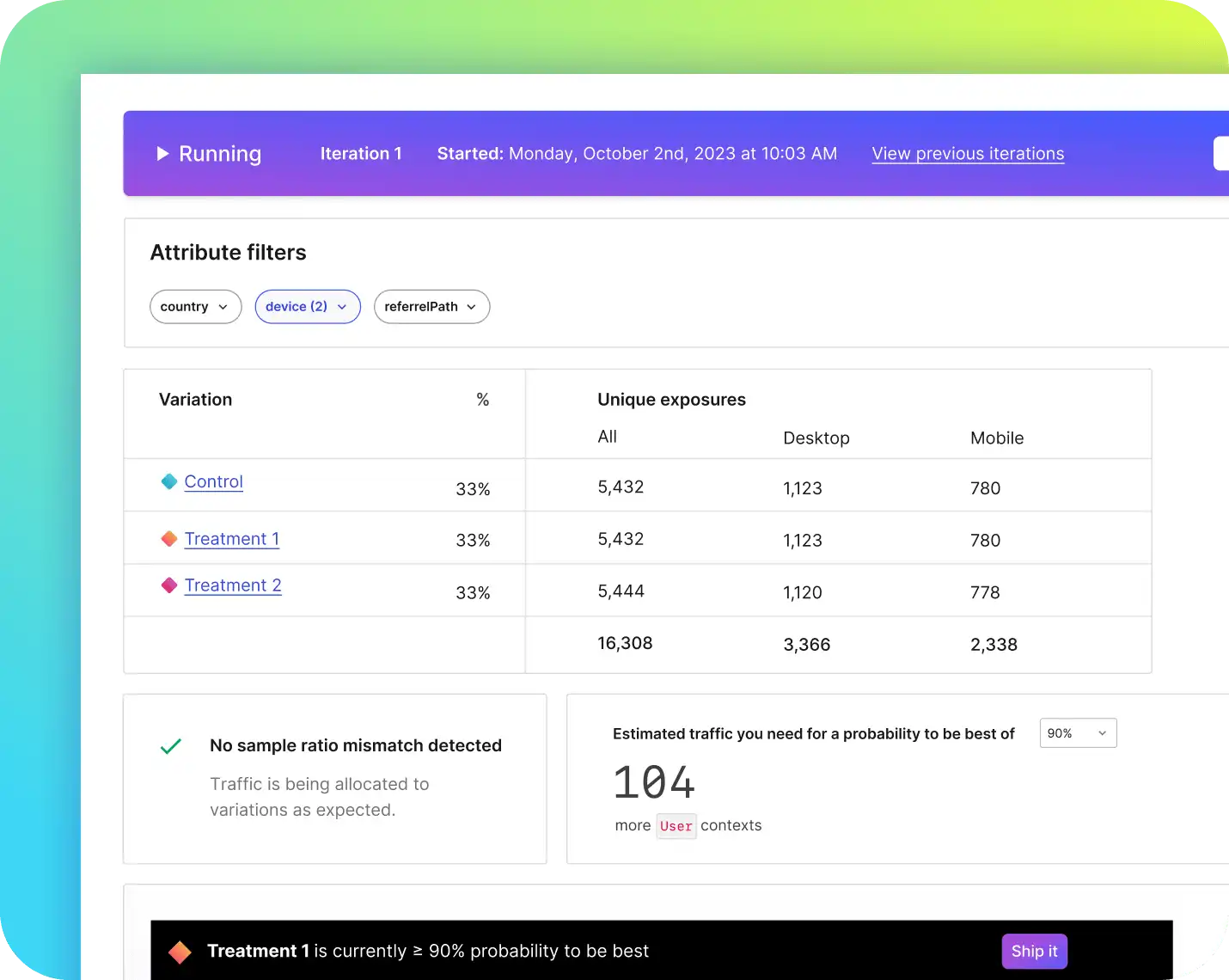
LaunchDarkly is an enterprise feature flag and A/B testing platform. It helps developers de-risk releases, target experiences, and optimize their products. It provides automation and governance features to ensure teams are following engineering best practices.
According to BuiltWith, as of September 2025, 1,052 of the top one million websites use LaunchDarkly, fewer than the 1,705 that use Statsig.
Key features
🚩 Feature flags: Control and target the release of features using multi-variate flags with real-time updates and local evaluation.
🧪 Experimentation: Run A/B/n tests against metric groups and segment. Easily roll out winning variants.
🤖 Automation: Advanced automations enable teams to not only schedule flag states, but do progressive rollouts and trigger workflows.
🔍 Governance: Audit flag changes. Get visibility into flag state across platforms. Use roles-based access controls to decide who can access and change flag states.
How does LaunchDarkly compare to Statsig?
LaunchDarkly and Statsig offer similar feature management and A/B testing features, though LaunchDarkly's lack of no code experiments and platform features might make it a less attractive option for non-technical users.
Why do companies use LaunchDarkly?
According to G2 reviews, users appreciate these aspects of LaunchDarkly:
SDKs: Reviewers appreciate how easy it is to integrate LaunchDarkly into their apps thanks to the range of SDKs they provide, like JavaScript, Python, Android, and iOS.
Automations: LaunchDarkly provides automations like scheduled rollouts, rollout templates, DevOps pipeline integrations, and stale flag cleanup.
Speed and availability: High uptime and speed are critical for developers. Reviewers highlight local caching and edge computing integrations as critical ways LaunchDarkly supports these.
Bottom line
LaunchDarkly is a good alternative if you desire more powerful feature management options compared to Statsig, though it doesn't offer some of Statsig's nice perks, such as unlimited seats and autocapture. Also, even though LaunchDarkly is working on product analytics and session replay, they are quite limited at the moment.
3. Amplitude
- Founded: 2012
- Most similar to: PostHog, Statsig
- Typical users: Product managers, data analysts, marketing teams
What is Amplitude?
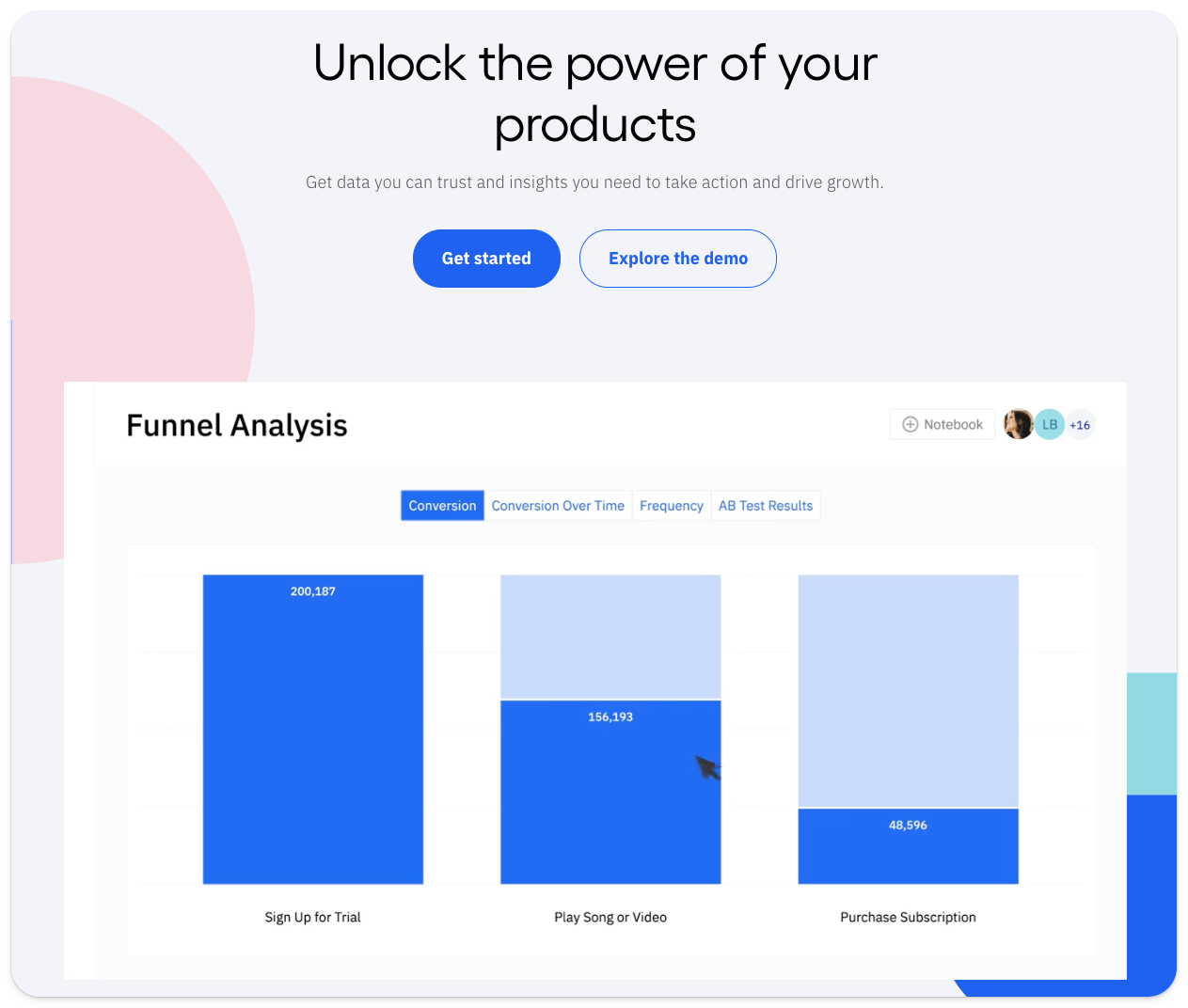
Amplitude was one of the original product analytics tools. Many large enterprise customers, like Ford, NBCUniversal, and Walmart rely on it. In recent years, it’s also added A/B testing, feature flags, session replays, and a customer data platform, making it an obvious alternative to Statsig.
Unsurprisingly, given it was founded in 2012, it's much more widely used. According to BuiltWith, as of September 2025, 6,310 of the top million sites use Amplitude, compared to Statsig's 1,705.
Key features
📈 Product analytics: Funnel and retention analysis, user paths, behavioral cohorts, custom dashboards, and more.
🧪 A/B testing: Test new features on specific targets and analyze with primary, secondary, and counter metrics.
👦 Customer data platform: Combine analytics data with third-party tools for data governance, identity resolution, and data federation.
🤖 AI insight builder: Generate insights based on natural language requests, like "What is my purchase conversion rate?"
How does Amplitude compare to Statsig?
Amplitude is missing some of the more complex statistical features of Statsig, but is very similar in terms of overall feature set.
Why do companies use Amplitude?
According to G2 reviews, people like Amplitude because:
It's simple to use: Amplitude makes it easy for non-technical users to get insights about their product and make improvements. Amplitude is built for users like product managers and marketers, making it a popular choice for them.
It offers built-in A/B testing: Amplitude offers integrated experimentation features. This enables companies to run experiments on existing cohorts, and then analyze the data in a single place.
It helps them become data-driven: Amplitude users appreciate it helps them become data-driven. It becomes easy to add data, visualize it, and make decisions, and they can use it as a source of truth thanks to its built-in customer data platform.
Bottom line
Like PostHog, Amplitude is a good alternative if you value powerful analytics and experimentation in one, though it's less geared to engineers than Statsig or PostHog.
4. Optimizely
- Founded: 2010
- Similar to: VWO
- Typical users: Enterprise marketing, frontend teams

What is Optimizely?
Optimizely is an all-in-one set of tools for marketing and product teams. It offers a combination of content management, marketing, web and feature experiments, and ecommerce optimization tools, all geared toward optimizing web experiences.
As one of the oldest alternatives in this guide, it's also one of the most widely used. According to data from BuiltWith, as of September 2025, Optimizely is deployed on 5,523 of the top 1 million websites, compared to Statsig's 1,705. Its popularity has declined in recent years, however, due in large part to greater competition – usage peaked at around 13,000 of the top million websites back in 2017.
Key features
🕸️ Web experimentation: Use Optimizely's visual editor and on-page previews to create frontend experiments quickly.
🧪 Feature experimentation: Run targeted experiments anywhere on your stack. View detailed reports on their impact.
🤹 Project management: Idea backlogs, workflows, and design tools to coordinate experiments and content.
📝 Content management system: Manage, deliver, and optimize your content in a centralized location.
💸 Ecommerce optimization: Customize checkout workflow along with CMS and experimentation to create the best possible commerce experience.
How does Optimizely compare to Statsig?
On paper, Optimizely is quite similar to Statsig, but it's more focused on marketing use cases, which is why it splits web experimentation and feature experimentation into two separate products. The former includes a no code, visual editor that's accessible for non-engineers.
Note: Although Optimizely was acquired by Episerver in 2020, they rebranded the combined company back to Optimizely in 2021.
Why do companies use Optimizely?
According to G2 reviews, people are fans of Optimizely because:
It's easy to use for non-engineers: Optimizely makes it easy for anyone to run web experiments thanks to a no code visual editor.
It integrates with their analytics platforms: Optimizely doesn't have built-in analytics, but reviewers appreciate its integrations with Google Analytics, Adobe Analytics, and others.
It's business-oriented: Optimizely focuses on optimizing business, marketing, and ecommerce use cases, and helps users improve the core business metrics they care about most.
Bottom line
Optimizely's platform, especially its mature no code experiment feature, makes it a good choice if you need a tool that's accessible for non-technical teams, such as marketing.
5. VWO
- Founded: 2009
- Similar to: Optimizely, PostHog
- Typical users: Product managers, engineers, UX designers
What is VWO?
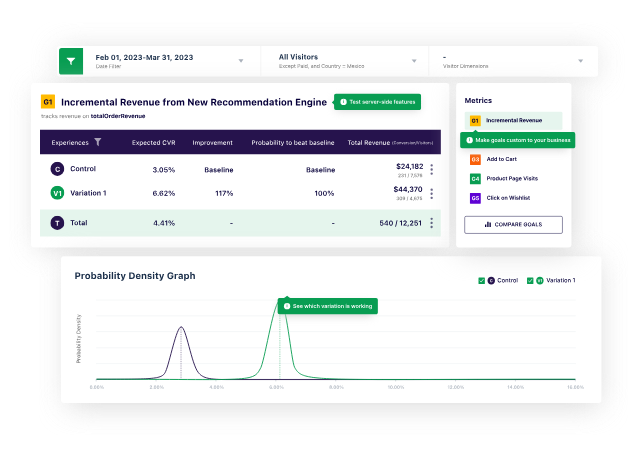
VWO is a digital optimization platform that aims to maximize conversion with tools like A/B testing, personalization, funnels, heatmaps, session replay, and customer analytics. The platform is home to multiple different products including testing, insights, data, personalize, plan, and web rollouts.
It's a popular tool – according to BuiltWith, as of September 2025 it's used by 10,673 of the top 1 million websites. It's grown noticeably in the last 12 months or so, likely due to customers migrating from Google Optimize, which was shut down in September 2023.
Key features
🧪 A/B testing: Improve conversion with web, mobile, and server-side A/B testing.
💽 Data platform: Collect and analyze custom data across your stack.
🤔 Insights: Understand your users with session recordings, heatmaps, analytics, and surveys.
👔 Personalization: Create and tailor user journeys and campaigns to the audience, location, and time.
📋 Planning: Ideate and plan optimization campaigns in one location.
How does VWO compare to Statsig?
VWO is closer to Optimizely than Statsig, though it offers most of the same features. It doesn't offer a complete product analytics tool, but it does offer basic funnel analysis, heatmaps, session replays, and user surveys as part of its wider platform. Unfortunately, many of these features are only available on their more expensive plans.
Note: Private equity firm Everstone acquired a majority stake in VWO in 2025.
Why do companies use VWO?
Based on G2 reviews, the biggest reasons to choose VWO are:
Support: VWO's support staff are knowledgeable, helpful, and responsive. This helps people get the most out of the platform from onboarding onwards.
Multi-use: Reviewers like that they can combine A/B tests with surveys, funnels, session replays, and analysis tools to optimize the complete user experience.
Data-focused: VWO enables both technical and non-technical users to make better data-driven decisions by being the complete source of experience data.
Bottom line
Like Optimizely, VWO is a good alternative to Statsig if you're looking for a tool anyone in your company can use. It offers a no code editor for marketing experiments, while also offering tools like heatmaps and replays that are useful for non-engineers.
6. GrowthBook
- Founded: 2020
- Similar to: LaunchDarkly, Statsig
- Typical users: Engineers and data scientists
What is GrowthBook?
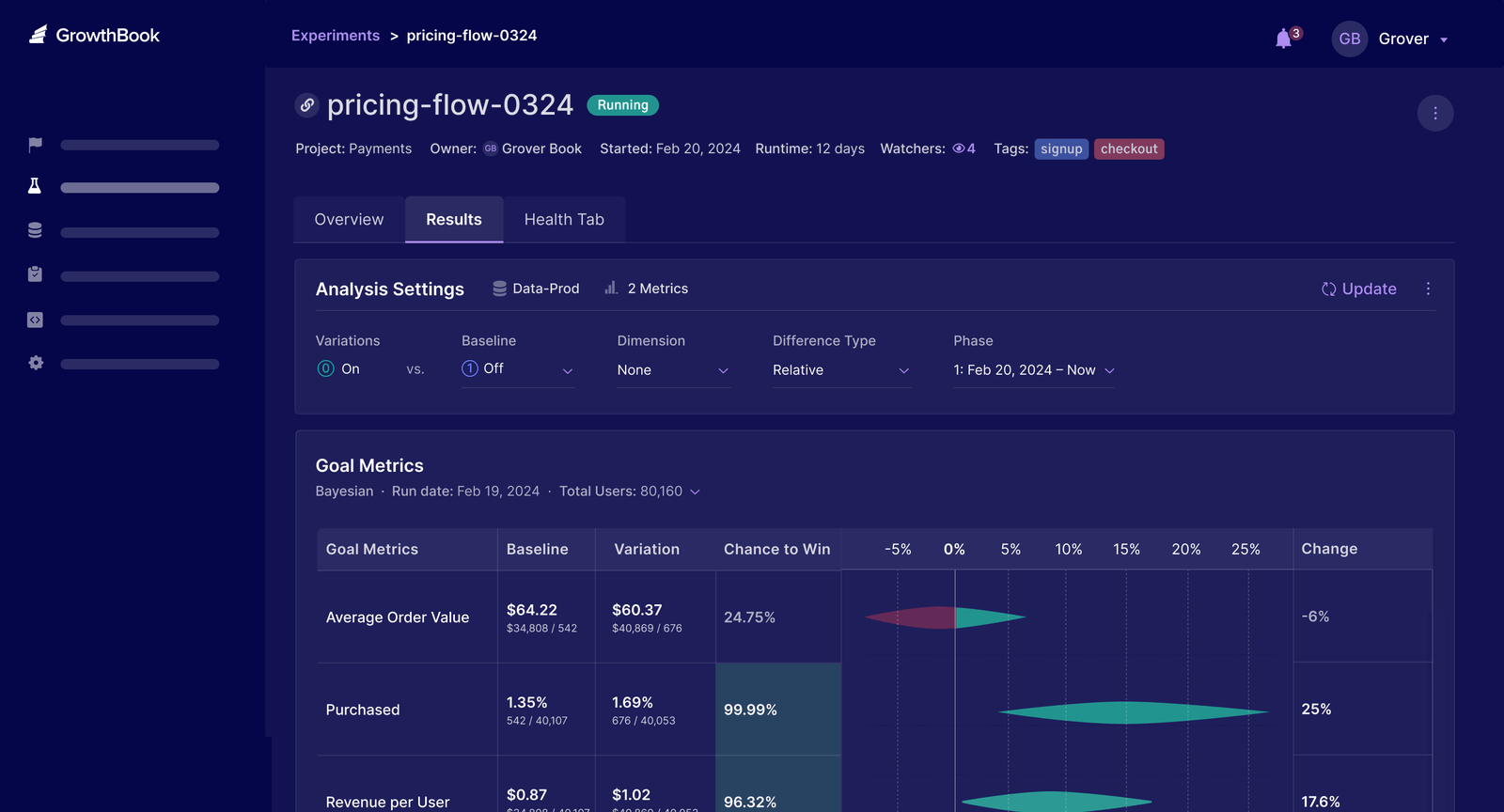
GrowthBook is a warehouse-native feature flag and experimentation platform. Its biggest selling point is integrating with the product and data tools you already use.
It's a popular choice for companies in strict regulatory environments because it is warehouse-native and self-hostable, but you can also use its hosted cloud version. It is also open source with 5.5k stars on GitHub.
Key features
🔧 Warehouse-native: Designed to integrate seamlessly with your existing data tools like Snowflake or Postgres.
🚩 Feature flags: Robust feature-flagging capabilities with custom targeting and scheduling.
🧪 A/B testing: Experimentation suite built on feature flags with a visual editor to optimize UI changes.
📊 Analysis: Use either Bayesian or Frequentist engines. Connect your existing data and do retroactive analysis.
🔌 Integrations: Connects with data warehouses and analytics tools, but has limited integrations beyond that.
How does GrowthBook compare to Statsig?
GrowthBook is a much more focused tool than others on this list. It is primarily a feature flag and experimentation platform, with a visual experiment editor that enables non-engineers to run simple web experiments. Its big differentiator is that it is open source and self-hostable.
Why do companies use GrowthBook?
According to G2, reviewers choose GrowthBook for the following reasons:
Warehouse-native: GrowthBook's integrations with the warehouses people are already using is a standout feature. It enables them to extract and make use of the data they already have.
Visual editor: The visual A/B test editor and experiment preview enable non-technical users to make full use of GrowthBook.
Self-hostable: Reviewers like that they have full control over GrowthBook by running it on their own infrastructure. This means no limits to data.
Bottom line
Being open source, free, and self-hostable, GrowthBook makes for a good alternative to Statsig, especially for companies in tricky regulatory situations.
7. Kameleoon
- Founded: 2012
- Similar to: LaunchDarkly, VWO
- Typical users: Product managers and developers

What is Kameleoon?
Kameleoon is a developer-focused complete optimization platform with A/B testing, feature management, and personalization. On top of these, it includes an AI copilot that helps generate options, do predictive targeting, assist in decisions, and more.
According to BuiltWith, as of September 2025, 941 of the top one million websites deploy Kameleoon, a little over half of Statsig's 1,705.
Key features
🌐 Web experimentation: Use their smart graphic editor and widget library to run flicker-free A/B tests on your website.
🚀 Feature experimentation: Do targeted rollouts of features and analyze their impact.
🤖 AI copilot: Have AI help with targeting, decision-making, and experiment creation.
📊 Stats accuracy: Provides advanced stats like sample mismatch ratio, cross-campaign analysis, CUPED, and multiple test correlation.
How does Kameleoon compare to Statsig?
Like Statsig, Kameleoon is an A/B testing platform first and foremost, though it hasn't branched into other arenas, like analytics. Its AI copilot feature is a major differentiator, while it can be self-hosted if this is a requirement for your business.
Why do companies use Kameleoon?
According to G2 reviews, users are big fans of the following aspects of Kameleoon:
Statistical tools: Reviewers are more confident about the results of their experiments thanks to Kameleoon's different statistical engines and AI copilot.
Editors: The combination of the graphics and widget editors makes it easy to set up A/B tests and personalizations.
Integrations: Reviewers like how Kameleoon integrates with all the tools they already use, like Google Analytics, Adobe Analytics, and Mixpanel.
Bottom line
For companies looking for a developer-focused optimization platform, Kameleoon is a good alternative. Though the lack of self-serve is a major downside.
Is PostHog right for you?
Here's the (short) sales pitch.
We're biased, obviously, but we think PostHog is the perfect Statsig replacement if:
- You value transparency. We're open source and open core.
- You want more than just A/B testing and feature flags. We have a full suite of product analytics, session replays, surveys, error tracking, and more.
- You want to try before you buy. We're self-serve with a generous free tier.
Check out our product pages and read our docs to learn more.
PostHog is an all-in-one developer platform for building successful products. We provide product analytics, web analytics, session replay, error tracking, feature flags, experiments, surveys, LLM analytics, data warehouse, CDP, and an AI product assistant to help debug your code, ship features faster, and keep all your usage and customer data in one stack.